


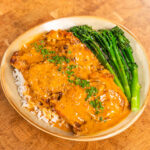


Pork belly cut into cubes, browned in its own fat, then tossed in a gochujang and honey glaze until it turns sticky and dark.
Jump to:
- Gochujang, Honey and Pork Belly You Cut Yourself
- Buying the Pork Belly, and What Bite Sized Means Here
- What Goes In, Including the Seasoning the Card Leaves Out
- How to Make Sticky Pork Belly Bites, Step by Step
- Browning the Pork Without Scorching the Honey
- What to Serve It With, and How It Keeps
- Frequently Asked Questions
- Sticky Pork Belly Bites
Gochujang, Honey and Pork Belly You Cut Yourself
These are cubes of pork belly, seasoned with four dry spices, browned in a pan, then coated in a glaze of gochujang, honey, dark soy sauce, garlic, ginger and rice wine vinegar. The recipe card below puts it at 15 minutes of prep and 20 minutes of cooking, so 35 minutes in total, and it makes 3 servings from 500g of pork belly.
The glaze is Korean. Gochujang is a fermented chilli paste built on chilli, glutinous rice and soybeans, and it is sweet and savoury before it is hot, which is why 2 tablespoon of it can carry a whole pan without making the dish punishing. The dish itself is not a traditional Korean one with a name and a history behind it. It is pork belly cooked the way a lot of Korean glazes are used, and it is worth saying plainly rather than dressing it up.
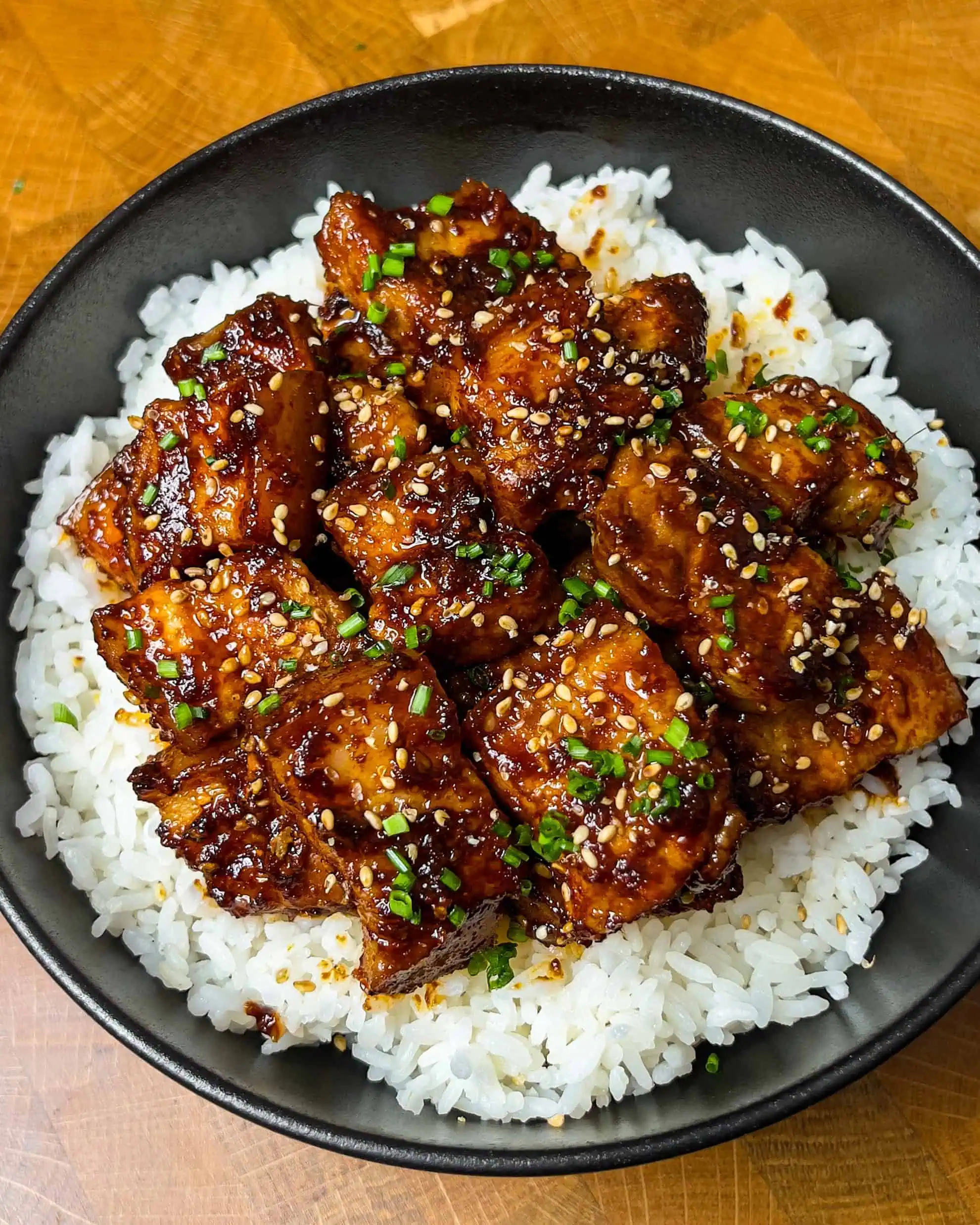
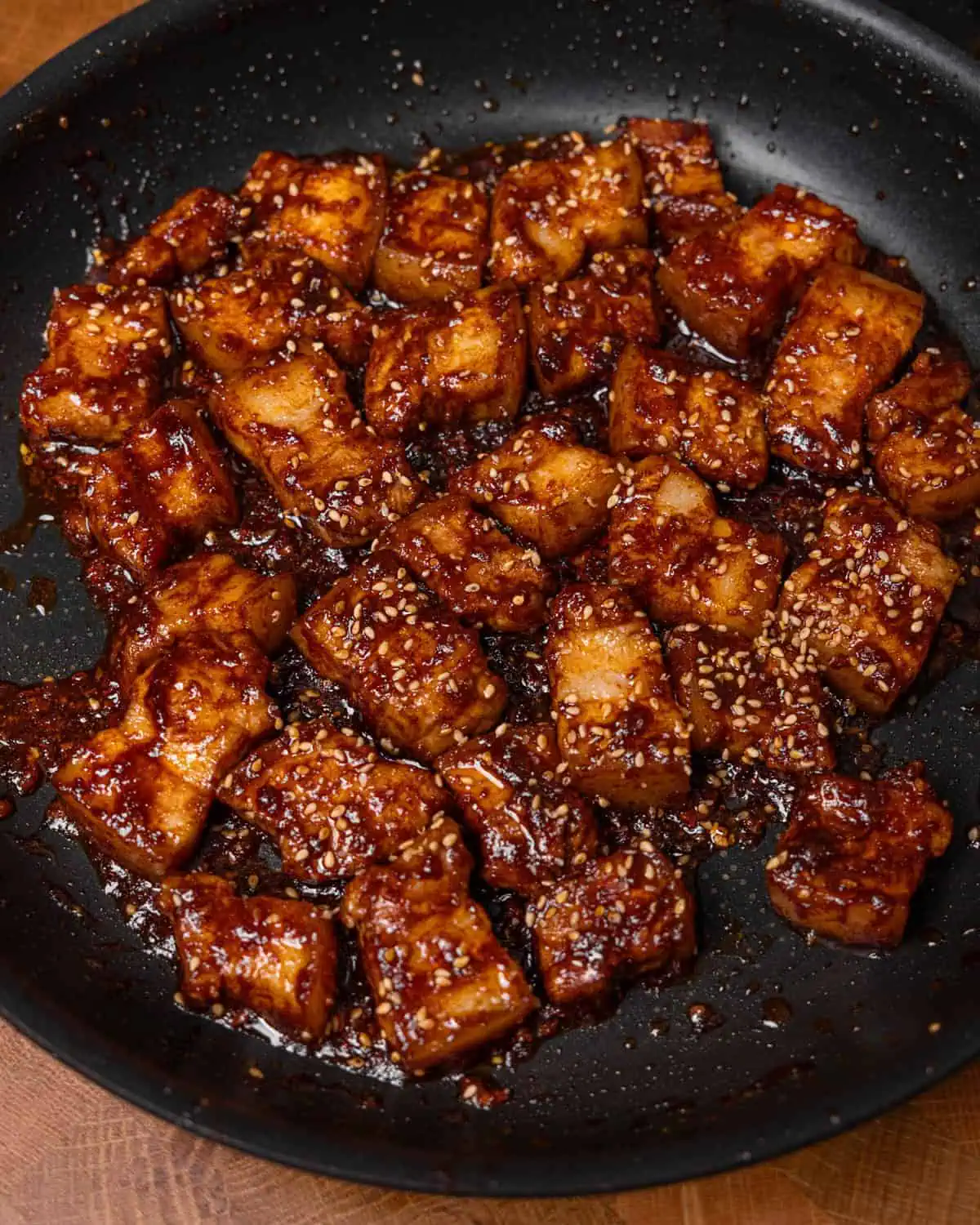
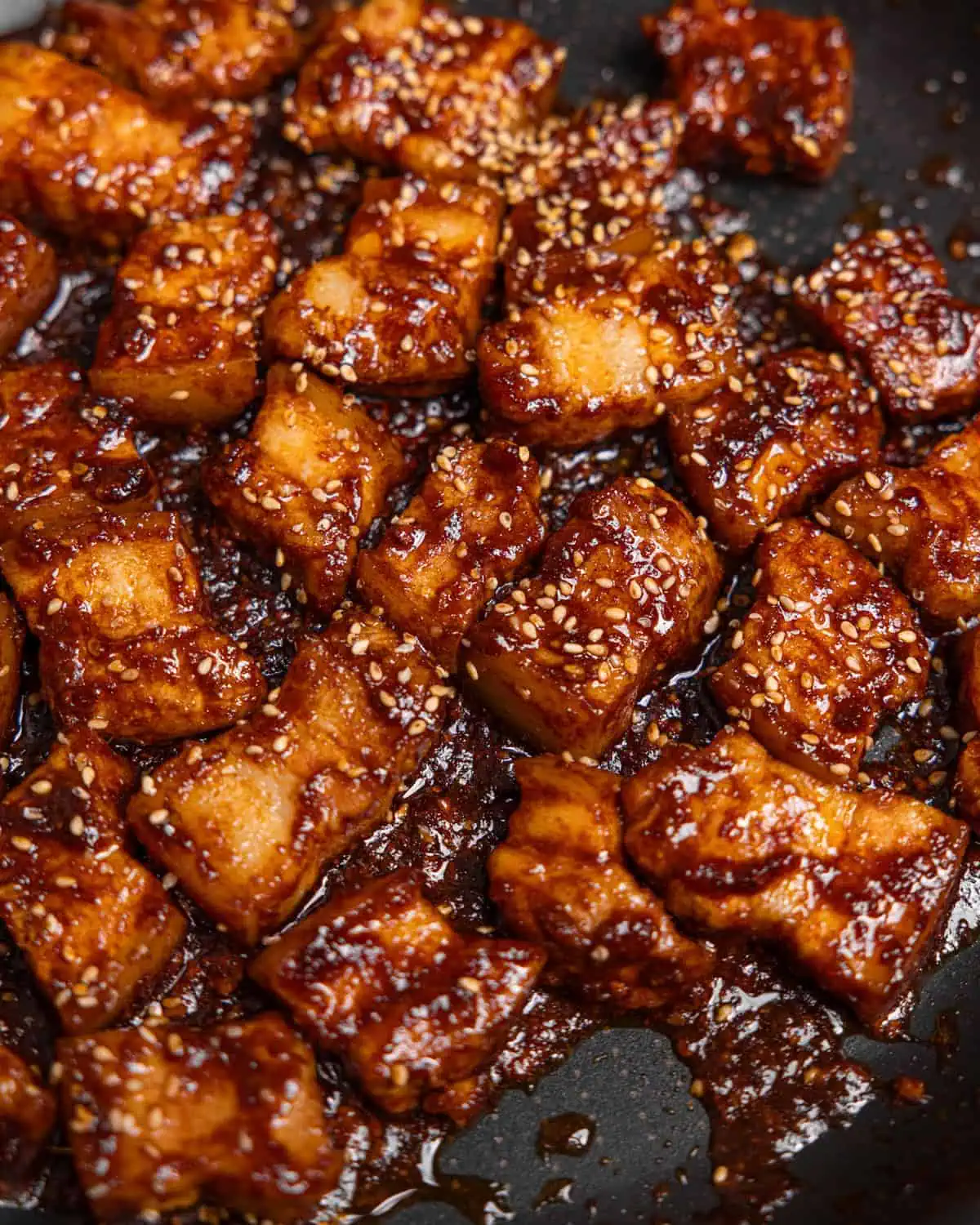
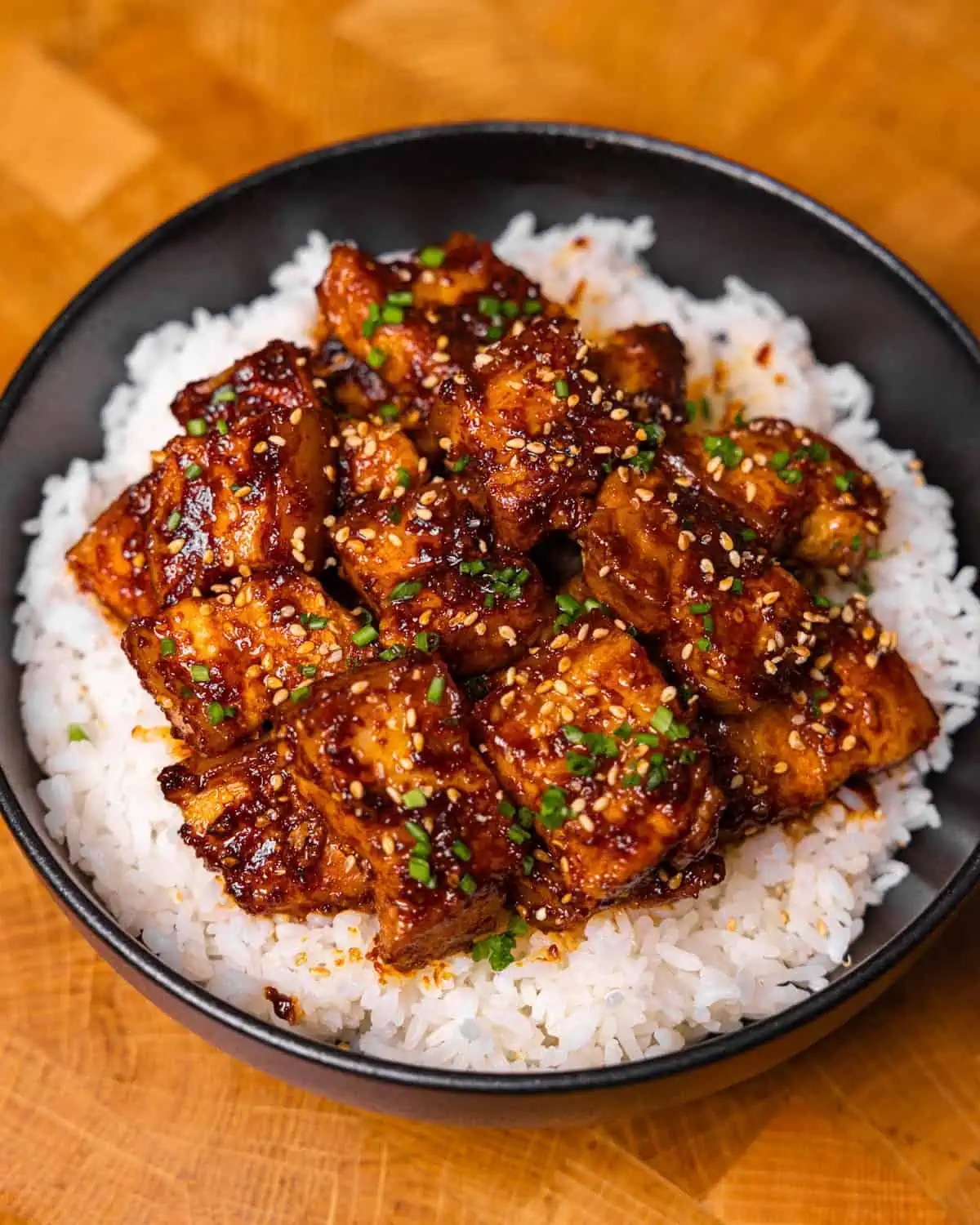
One expectation to set before you start: this comes out sticky, not crunchy. The pork browns and the fat renders while it is in the dry pan, and the edges firm up. Then 2 tablespoon of honey and 2 tablespoon of gochujang go in and reduce around the cubes, and a glaze that thick is the opposite of a crisp coating. Every finished photo on this page shows the same thing: dark, glossy, lacquered. That is the dish working correctly. If you are after crackling and shatter, this is not the recipe for it.
Buying the Pork Belly, and What Bite Sized Means Here
The card asks for 500g of pork belly, sliced into bite sized pieces. Buy it as slices or as a slab and cut it down yourself. What you are looking for on the shelf is a piece with clear, even layers of fat and meat rather than one that is mostly fat at one end. Those layers are the whole point: the fat renders in the pan and does the frying, which is why this recipe never asks you to add any oil.
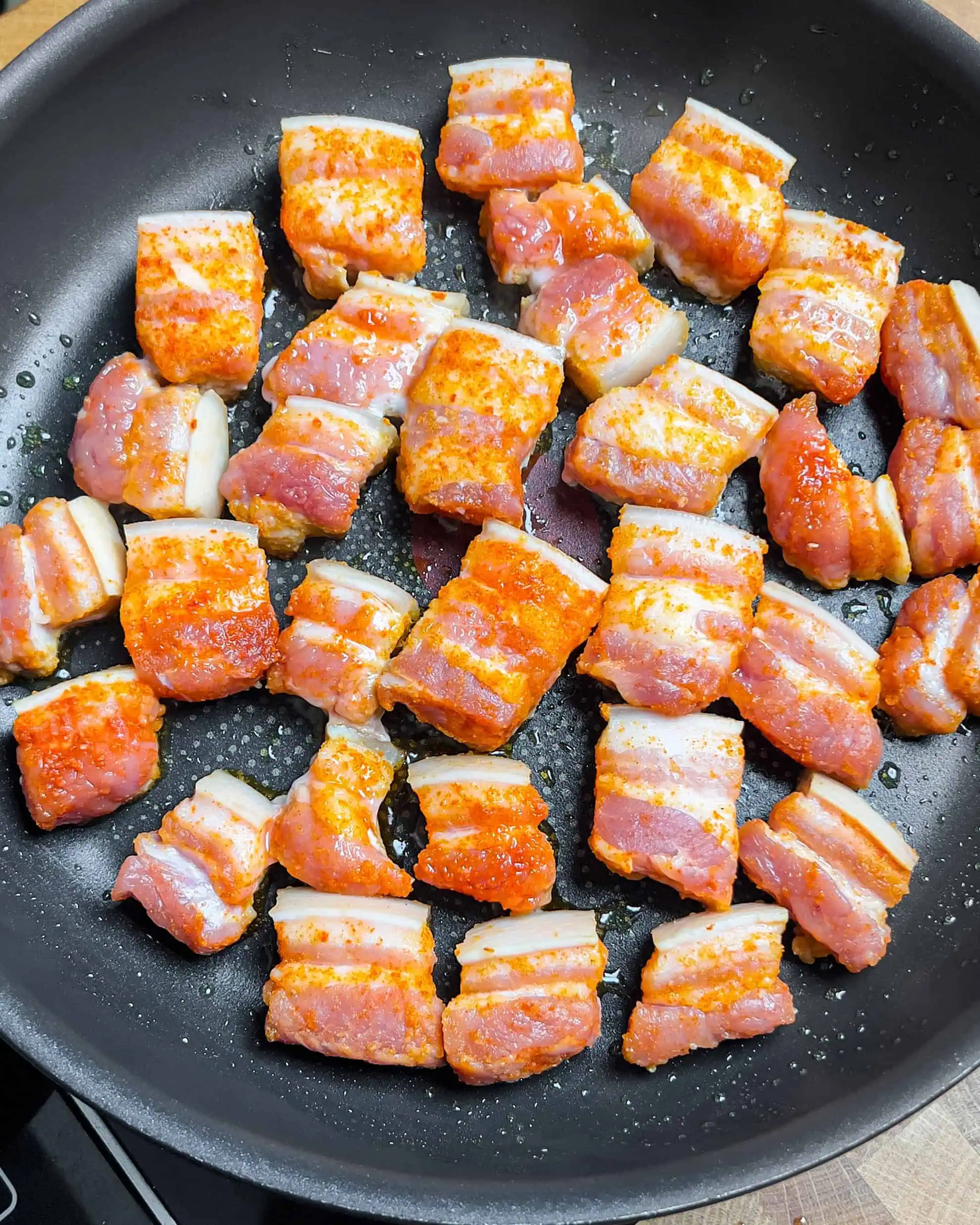
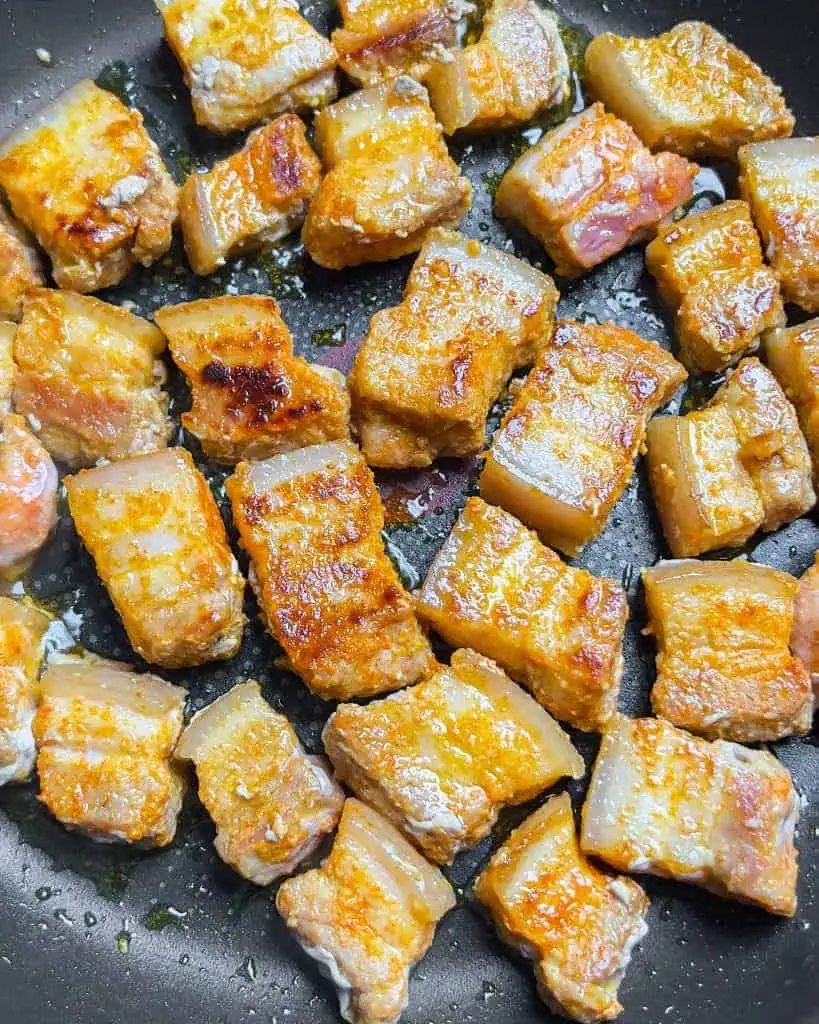
Bite sized here means roughly 2 to 3cm cubes, which is what the step photos show, about thirty of them from 500g. Size matters more than it sounds. Cut them smaller and the fat renders out before the glaze goes anywhere, and you end up with hard little nuggets. Cut them much bigger and 5 minutes a side will not get the middle where you want it.
If you want pork belly in a slab rather than in cubes, Char Siu Pork Belly uses the same 500g and takes the same 35 minutes, but goes the Chinese route with hoisin, five spice and honey instead of gochujang.
What Goes In, Including the Seasoning the Card Leaves Out
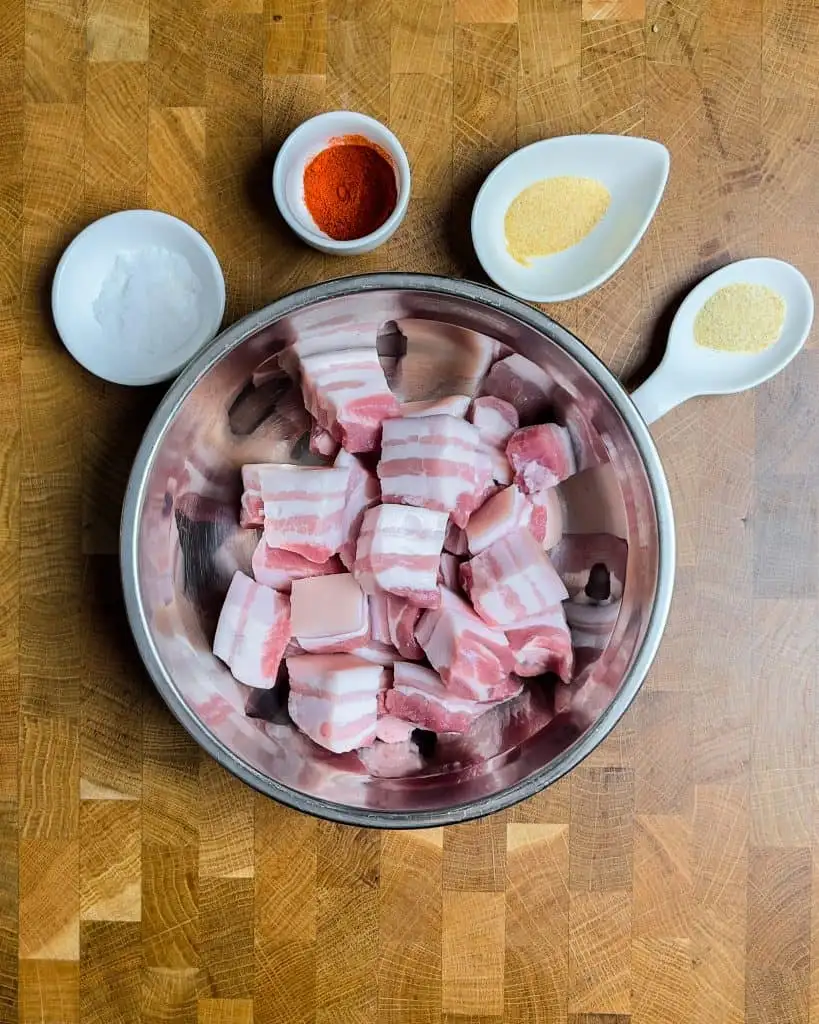
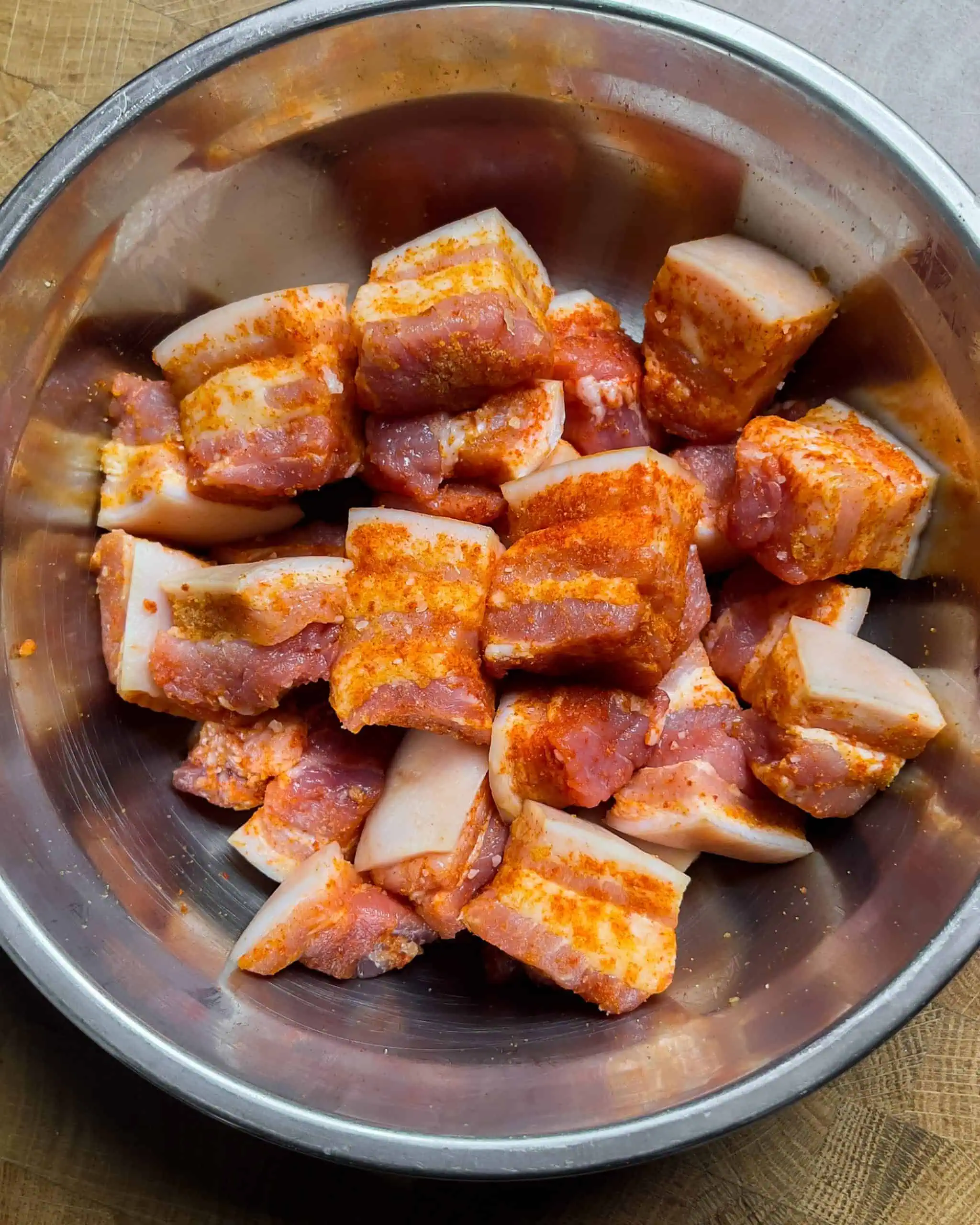
Read this part before you cook, because the recipe card has a gap in it. The card lists chilli powder, garlic powder, onion powder and salt in its ingredients, but none of its five numbered steps ever tells you to use them. They go on the raw pork, before it hits the pan, and the step photo of the spice coated cubes in a steel bowl is the proof. Follow the card's steps literally and you will leave four of its twelve ingredients sitting on the bench.
On the Pork
- Pork belly, 500g, cut into bite sized pieces: the whole dish. It brings its own fat, so no oil is needed anywhere in this recipe.
- Chilli powder, ½ tsp: the heat that sits on the meat itself rather than in the glaze. It is also what gives the raw cubes that red coating in the photos.
- Garlic powder, 1 tsp: the largest of the four dry seasonings, and it is doing a different job from the garlic paste in the glaze. Powder on the surface browns with the meat, paste in the sauce stays sharper.
- Onion powder, ½ tsp: background sweetness and savour under the chilli.
- Salt, ½ tsp: seasons the pork from the outside before the glaze adds its own salt. Worth knowing that the dark soy sauce and the gochujang are both salty, so there is no need to add more later.
The Gochujang Glaze
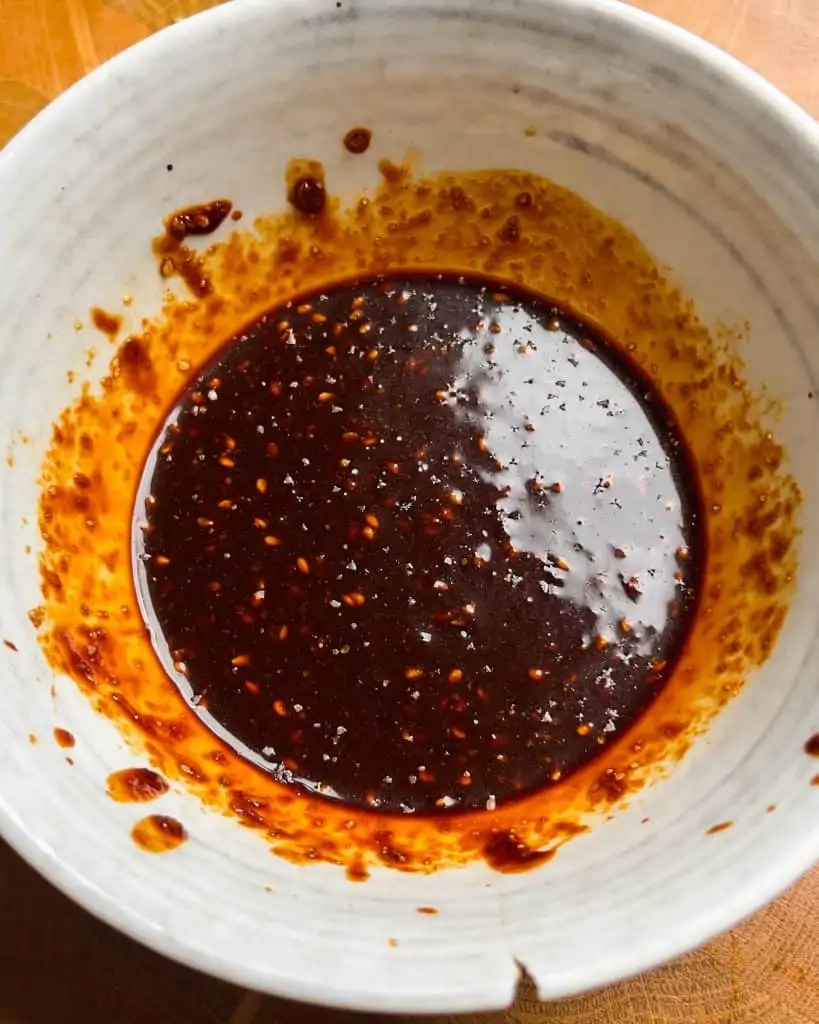
All of it gets stirred together cold while the pork is browning, then goes into the pan in one go.
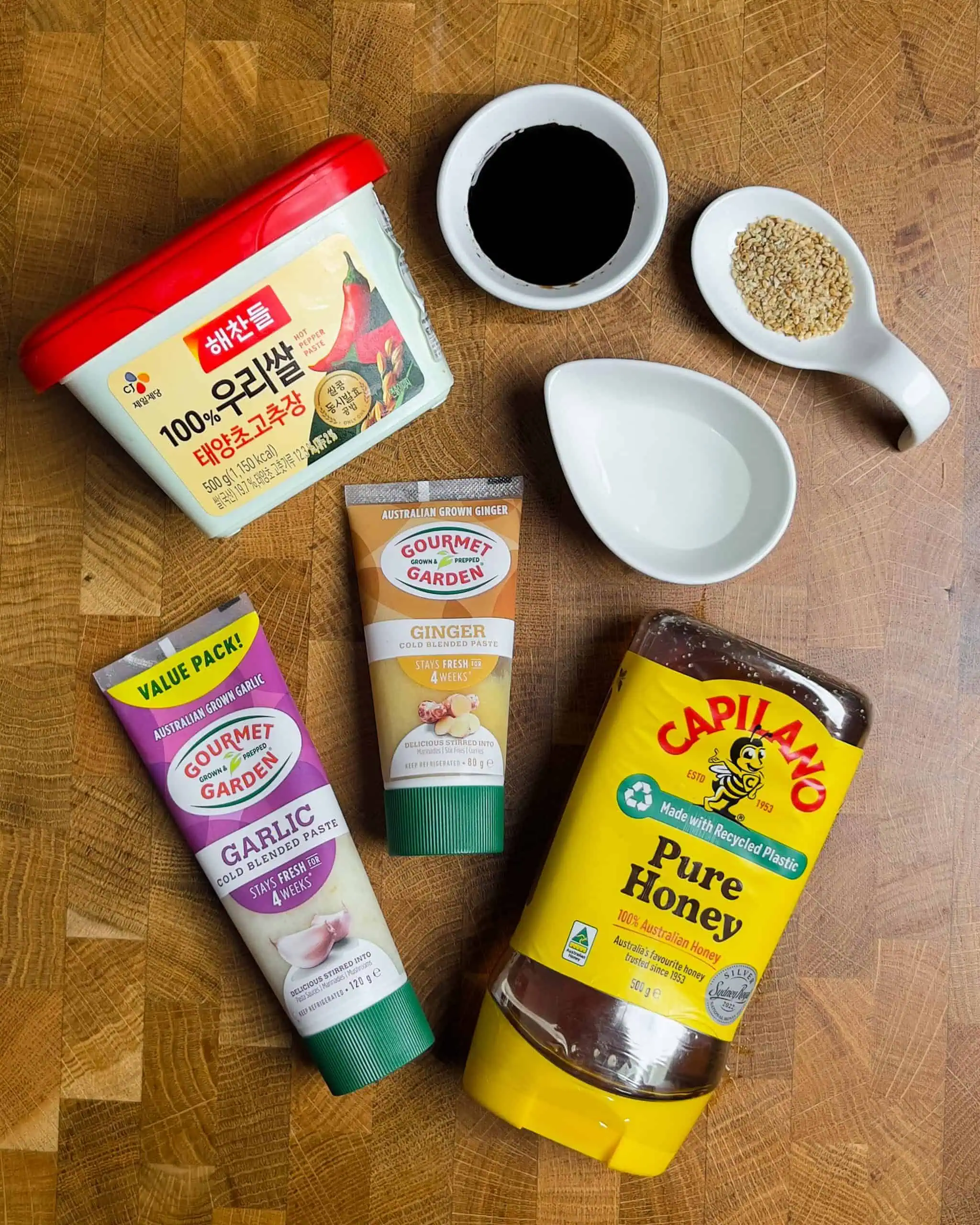
- Gochujang, 2 tbsp: the body of the sauce and most of its colour. If you have a tub open already, Korean Army Stew uses the same 2 tablespoon in a completely different direction, as the base of a broth rather than a glaze.
- Honey, 2 tbsp: the stickiness, and the reason the sauce thickens around the cubes instead of staying watery. It is also the ingredient that decides how hot your pan can be, which is the next section.
- Dark soy sauce, 1 tbsp: colour and depth. Dark soy is less salty and more molasses-like than light soy, and it is a lot of what makes the finished glaze read almost black rather than red.
- Garlic paste, 1 tsp and ginger paste, 1 tsp: both go in raw and cook in the pan in the minute or two the sauce is reducing. Paste rather than chopped matters at this length of cooking, because chopped aromatics would still be raw when the glaze is done.
- Rice wine vinegar, 1 tbsp: the only sour thing in the pan, and it is working against 2 tablespoon of honey. Leave it out and the glaze is cloying rather than balanced.
- Sesame seeds, 1 tsp: these go into the sauce mix at step 2, and the card also calls for sesame seeds on top at step 5 without listing a second quantity. So 1 teaspoon is all you have for both jobs. If you want a visible scatter on the finished bowl like the photos, buy more than the card asks for.
On Top
- Chives: they appear in the card's final step and in every finished photo, but they are not in the card's ingredient list at all, so they are easy to miss at the shops. Get a bunch. They are the only fresh thing on a plate of salty, sweet and rich.
- Rice: same situation. The last step says to serve this with a bowl of rice and the ingredient list does not mention it, so put it on before you start cooking.
How to Make Sticky Pork Belly Bites, Step by Step
These follow the five numbered steps on the recipe card, with the seasoning put back into step 1 where the photos show it happening.
- Cut the pork belly slices into bite sized pieces, then toss them in a bowl with the chilli powder, garlic powder, onion powder and salt until every cube is coated.
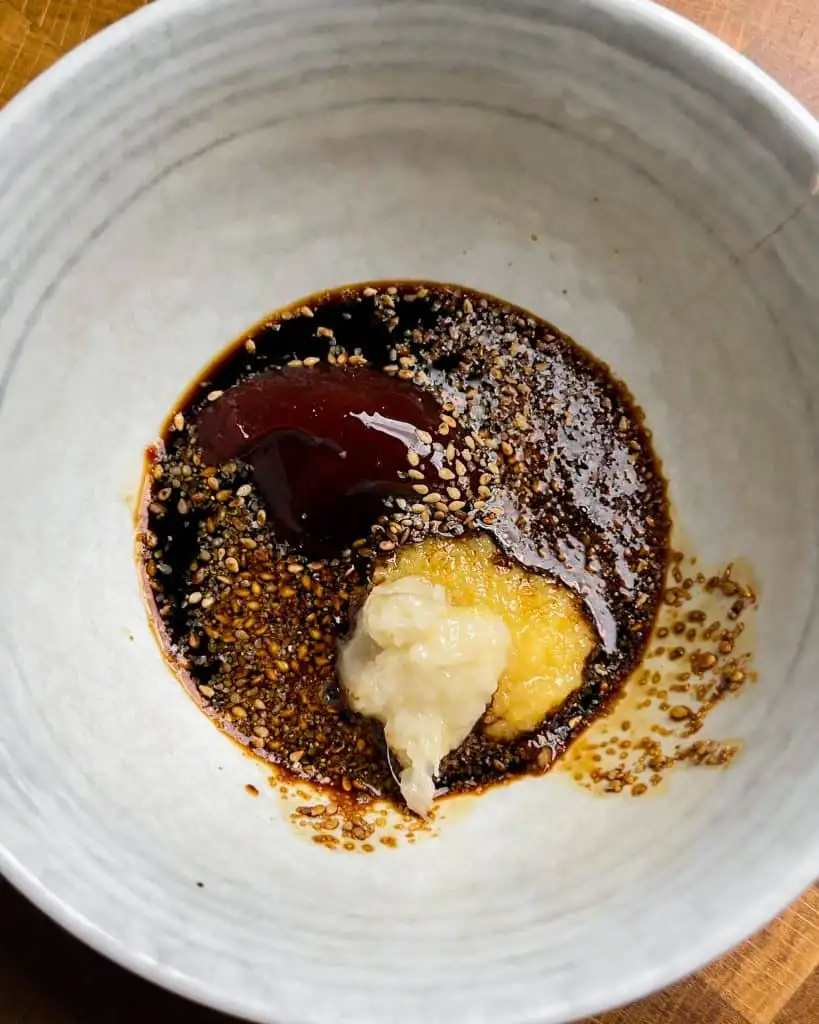
- For the sauce, mix the gochujang, garlic paste, ginger paste, dark soy sauce, honey, rice wine vinegar and sesame seeds. Set aside.
- Heat a pan over medium-high heat. Add the pork to the pan and cook each side for 5 minutes or until golden brown. No oil goes in: the belly renders enough of its own within the first minute.
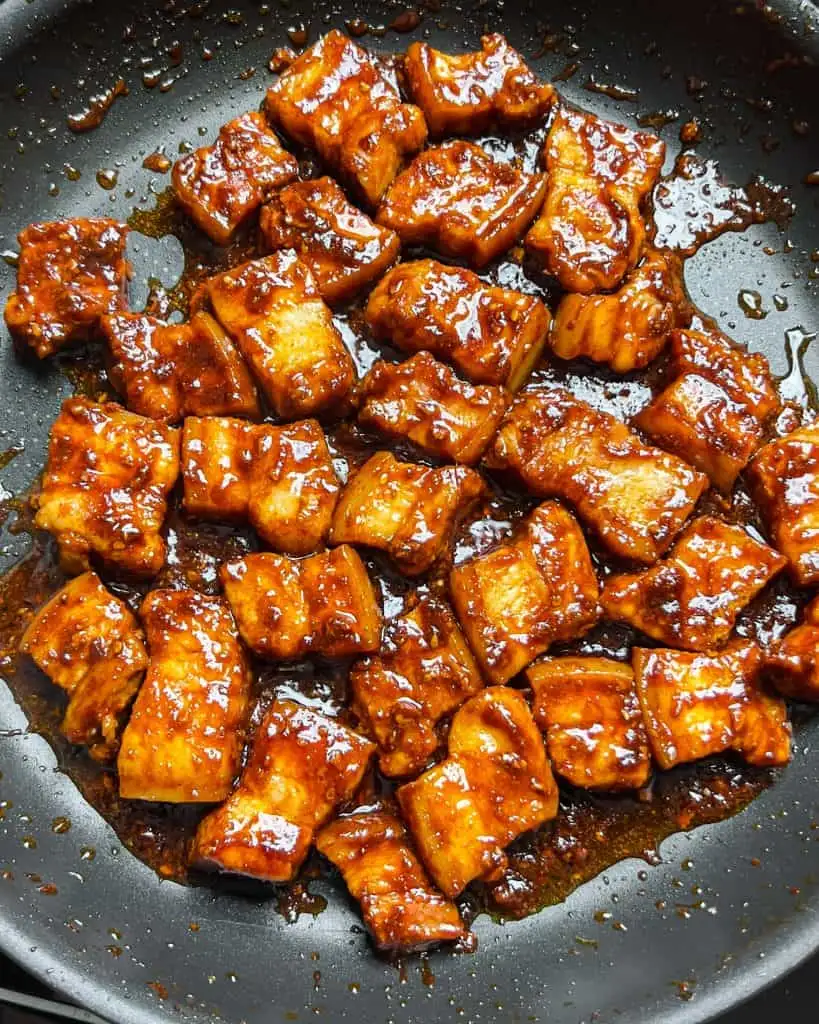
- Add the sauce to the pan and toss until everything is coated with the sauce. It will look loose for the first minute, then tighten and darken around the cubes.
- Once it is done, serve with a bowl of rice, garnish with sesame seeds, chives and enjoy!
Browning the Pork Without Scorching the Honey
This is the part of the recipe that actually goes wrong, and it goes wrong in one specific way: the heat that is right for the pork is too high for the glaze.
The card says medium-high, and medium-high is the number to follow. Pork belly wants a hot enough pan to render fat and colour the outside inside 5 minutes a side. Turn it up past that and you are burning the outside of the cubes before the fat underneath has had time to melt, which is how you get a piece that looks cooked and eats greasy.
Then the glaze arrives, and the sum changes. There is 2 tablespoon of honey in that bowl, and sugar in a hot dry pan goes from caramel to acrid fast and without much warning. So the moment the sauce goes in, the pan should be coming down, not staying up. The whole job of step 4 is to reduce the sauce enough that it clings, which takes a minute or two, not to cook the pork any further. The pork was already done at the end of step 3.
What you are watching for is easier to see than to time. The sauce goes in thin and slides around the pan. It starts to bubble in bigger, slower bubbles as the water cooks off. Then it stops pooling and starts coating, and when you push a cube across the pan the glaze follows it instead of running back. That is the moment it is done, and it is also the last moment before it starts to catch.
If you want it hotter, more gochujang is the lever, not more chilli powder, because the gochujang brings sweetness and body along with the heat and the chilli powder only brings heat. For a different glaze on the same idea, Filipino Pork Tocino sweetens pork with brown sugar and pineapple juice instead and has no chilli in it at all.
What to Serve It With, and How It Keeps
Plain steamed rice is what the recipe card asks for and it is the right call, because the glaze is strong enough that anything competing with it is wasted. The rice is there to carry it. If you would rather the rice did some work too, Kimchi Fried Rice is built on the same 2 tablespoon of gochujang, so the two sit together rather than fighting.
Three servings of this is a lot of rich food, so the other way to use it is in smaller amounts: on toothpicks as something to hand around, or spooned over a crunchy, sharp salad where the glaze acts as the dressing and the fat is cut by something raw.
Keeping it. In an airtight container in the fridge it holds for up to 3 days, and it freezes for up to 2 months. Thaw it in the fridge overnight before reheating.
Reheating it, honestly. An air fryer or a hot pan will get the edges back to something close to how they started. A microwave is faster and it will not crisp anything, because it heats the moisture in the food rather than drying the surface, so what you get is soft glazed pork. That is fine if it is going over rice anyway. Cold pork belly fat sets firm, so take it out of the fridge a little ahead whichever route you take.
Frequently Asked Questions
Can I make Sticky Pork Belly Bites in an air fryer?
You can cook the pork that way, but this recipe is not written for it and the card gives no air fryer temperature or time, so you would be working those out yourself. The thing that does not change is the glaze: honey and gochujang need a pan to reduce in, and sprayed onto pork in an air fryer basket they burn onto the basket rather than thicken. So the air fryer route is season the cubes, cook them until browned, then tip them into a pan with the sauce for the last minute. One note on the old advice that an air fryer saves you oil here: this recipe never uses any oil to begin with, because the belly renders its own.
What can I use as a substitute for gochujang?
A mix of red pepper flakes and a little miso paste gets you closest, because miso brings the fermented, savoury depth and the flakes bring the heat. What it will not bring is gochujang's own sweetness or its thickness, so the glaze will be thinner and sharper than the photos. There is already 2 tablespoon of honey in the sauce doing some of that work, which is why the swap holds up at all.
Can I use this recipe for a pork belly dinner?
Yes, that is what the 3 servings on the card assume: the pork over rice as the main thing on the plate. Something green and sharp alongside it earns its place, because there is nothing acidic in the dish apart from 1 tablespoon of vinegar in the glaze.
How long can I store leftover pork belly in the fridge?
Up to 3 days in an airtight container, or up to 2 months in the freezer. The glaze firms up in the cold, which is normal and loosens again as soon as it is warm.
RATE MY DISH!
If you enjoy my Sticky Pork Belly Bites make sure to leave a comment and rating down below. I highly appreciate it!
Tag me on Instagram @geniuseatss so I can see your creation! Don't forget to follow me on TikTok, Youtube, Pinterest and Facebook for more recipes and contents!
Thank you so much and enjoy my recipes!
PrintSticky Pork Belly Bites

Savor the irresistible sweetness and crunch of these sticky pork belly bites!
- Prep Time: 15 minutes
- Cook Time: 20 Minutes
- Total Time: 35 minutes
- Yield: 3 servings 1x
- Category: Korean
- Method: Easy
- Cuisine: Asian
Ingredients
- 500g of pork belly, slice into bite sized pieces
- ½ tsp of chilli powder
- 1 tsp of garlic powder
- ½ tsp of onion powder
- ½ tsp of salt
Korean Glaze:
- 2 tbsp of Gochujang or Korean Chili Paste
- 1 tsp of garlic paste
- 1 tsp of ginger paste
- 1 tbsp of dark soy sauce
- 2 tbsp of honey
- 1 tbsp of rice wine vinegar
- 1 tsp of sesame seeds
Instructions
- Cut the pork belly slices into bite sized pieces.
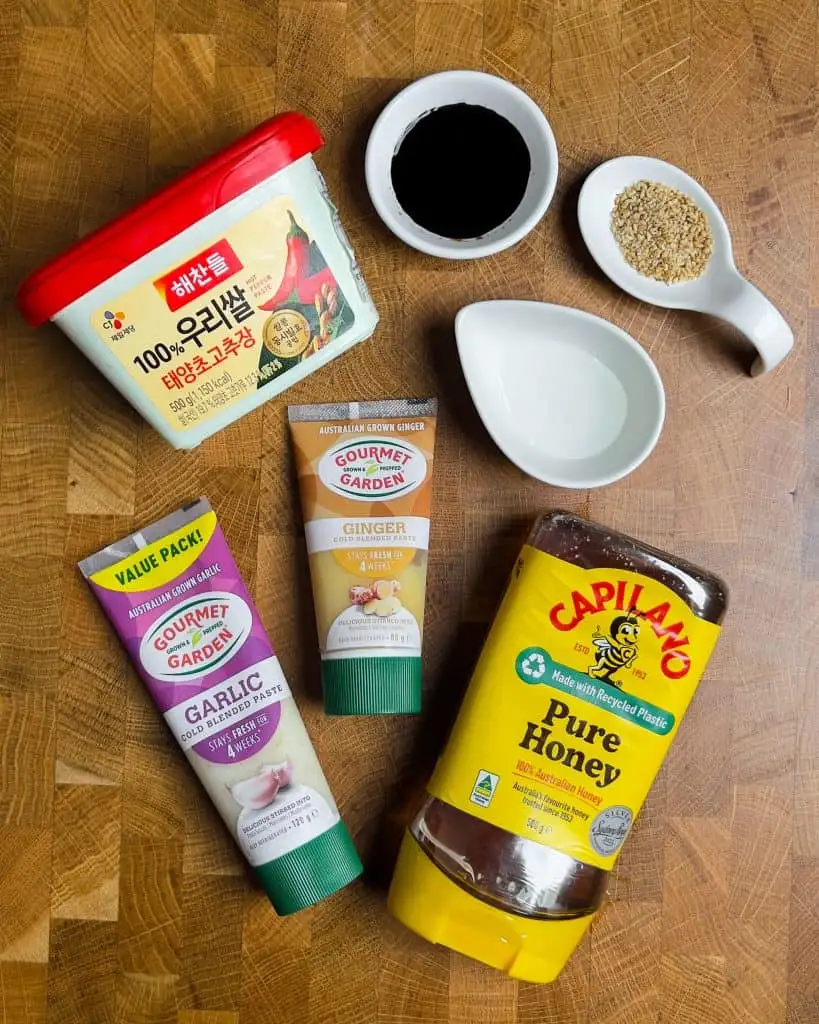
- For the sauce, mix Gochujang, garlic paste, ginger paste, dark soy sauce, honey, rice wine vinegar and sesame seeds. Set aside.
- Heat a pan over medium-high heat. Add the pork to the pan and cook each side for 5 minutes or until golden brown.
- Add the sauce to the pan and toss until everything is coated with the sauce.
- Once it is done, serve with a bowl of rice, garnish with sesame seeds, chives and enjoy!

droversointeru
Hey there! Do you know if they make any plugins to safeguard against hackers? I'm kinda paranoid about losing everything I've worked hard on. Any tips?
Wendy
Hello there! I know this is kinda off topic but
I was wondering which blog platform are you using for this website?
I'm getting fed up of WordPress because I've had issues with hackers and I'm looking at alternatives for another platform.
I would be awesome if you could point me in the direction of a good platform.
Salvador
Aw, this was a very nice post. Finding the time and
actual effort to create a top notch article… but what can I say… I put things
off a whole lot and don't manage to get anything done.
Molly
My brother recommended I might like this website.
He was entirely right. This post actually made my day. You cann't imagine just how much time I had
spent for this information! Thanks!
Milford
I just could not depart your site before suggesting that I actually loved the standard information an individual provide
on your guests? Is going to be back ceaselessly in order to
check out new posts
Aracely
hi!,I love your writing so a lot! percentage we communicate extra
about your article on AOL? I need a specialist on this area
to solve my problem. Maybe that's you! Taking a look ahead to look you.
Quincy
I was recommended this blog via my cousin. I'm not sure whether this post is written by
him as nobody else recognize such particular approximately my problem.
You are amazing! Thank you!
Lyda
Excellent post. I was checking constantly this blog and I am impressed!
Extremely useful information particularly the last part :
) I care for such info much. I was seeking this particular info for
a long time. Thank you and good luck.
Charolette
Hello my friend! I wish to say that this article is amazing, nice written and come with almost all
vital infos. I'd like to see more posts like this .
Tim
Undeniably believe that which you stated. Your favorite justification appeared to be on the web
the simplest thing to be aware of. I say to
you, I certainly get irked while people consider worries
that they just do not know about. You managed to hit the nail
upon the top and defined out the whole thing without having side-effects , people can take a
signal. Will probably be back to get more. Thanks
canadian pharmaceuticals usa
What's up, its nice paragraph regarding media print, we all understand media is a wonderful source of data.